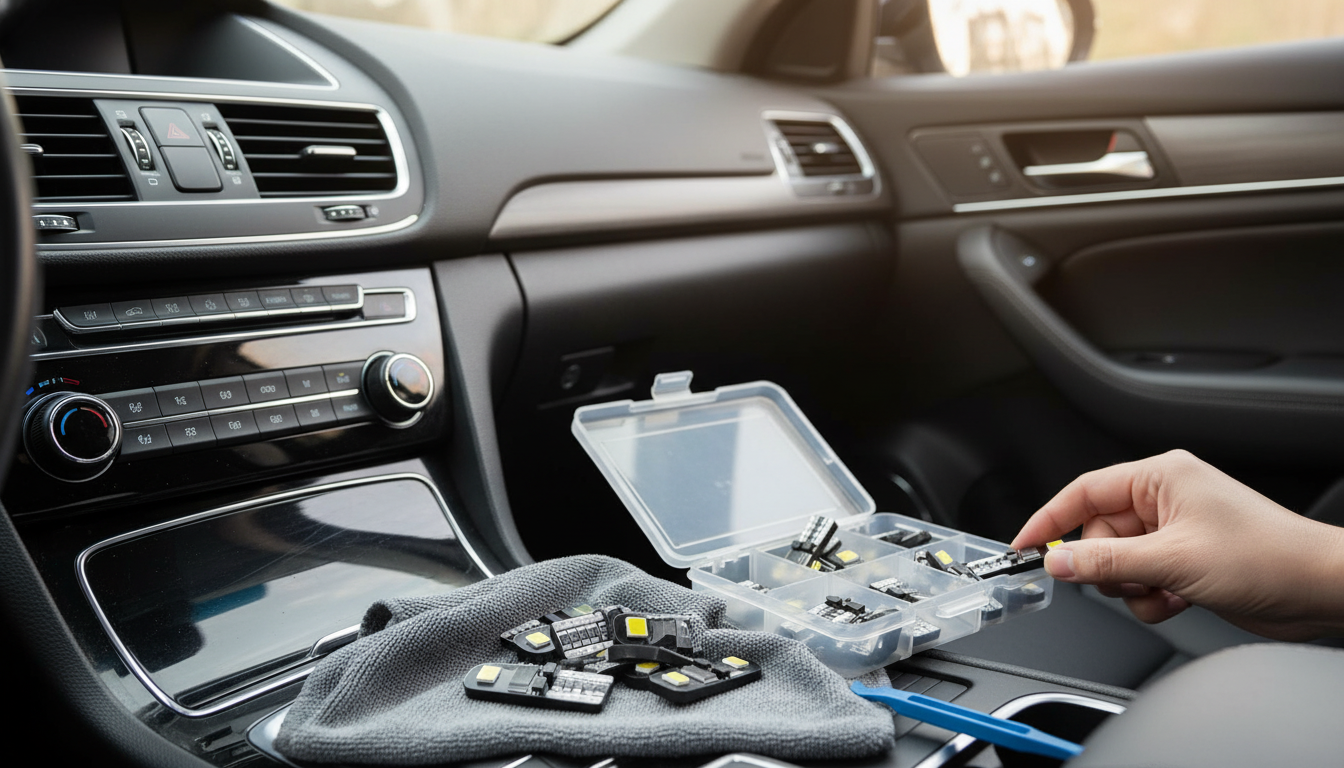
A quick interior lighting refresh can make a cabin feel cleaner, brighter, and more modern. T10 LED Canbus bulbs are designed to work with many factory bulb-monitoring systems, helping reduce flickering and dashboard bulb warnings while upgrading common interior locations like dome, map, glove box, trunk, and door courtesy lights. For Mercedes, BMW, and Audi drivers in particular, choosing a “no-error” style LED can make the difference between a smooth install and a cabin full of annoying warning messages. For more guidance, see Full LED Interior – Mercedes-Benz Forum.
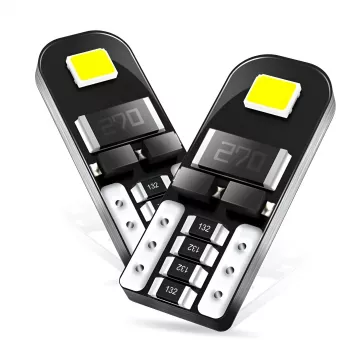
T10 bulbs are one of the most common small wedge-base bulbs used across interior and accent lighting. When you replace older halogen wedges with LED versions, you typically get a whiter color, faster on/off response, and a more even-looking cabin—especially when multiple bulbs are swapped at once. For further reading, see AZN Optics 5W5 Canbus LEDs – MBWorld.org Forums.
If you’re unsure about bulb numbering and fitment conventions, mainstream lighting references like Sylvania Automotive Lighting can help you confirm the common bulb types used in different applications.
Many German vehicles use bulb-out detection that monitors current draw. Standard LEDs often consume less power than halogen bulbs, and the vehicle may interpret that lower draw as a failed bulb—even when the LED is working fine. That’s where Canbus-focused “no error” LEDs come in.
| Symptom | What it usually means | Typical fix |
|---|---|---|
| Dashboard bulb warning / “lamp out” message | Current draw detected as too low | Use Canbus LED or add proper load resistors where appropriate |
| Flicker when lights are on | PWM dimming or unstable driver behavior | Try Canbus bulb; ensure firm fit and clean contacts |
| Brief pulse when lights are off | Bulb-check signal present | Canbus bulb; sometimes a resistor/capacitor module is needed |
| One bulb doesn’t light | Polarity mismatch or poor contact | Flip the bulb 180° (if non-polar), reseat, check socket tension |
For additional retrofit compatibility notes and why some vehicles behave differently, you can also review guidance from major manufacturers like OSRAM Automotive.
A 10-piece kit is a practical middle ground: enough bulbs to cover several interior positions, plus a couple of spares for the glove box or trunk where bulbs are easy to drop or misplace during installation.
A small tip for a more “factory” finish: replace bulbs in pairs (left/right map lights, footwell pair, vanity pair) so the tone and brightness match evenly.
T10 / W5W / 194 wedge bulbs are common, but not universal. Some vehicles mix bulb types across different interior fixtures, even within the same model year—so it’s worth checking each location you plan to upgrade.
| Bulb type | How to recognize it | Typical interior location examples |
|---|---|---|
| T10 / W5W / 194 (wedge) | Flat wedge base that pushes into the socket | Glove box, footwell, door courtesy, some map/dome setups |
| Festoon | Cylinder/“tube” bulb with metal ends | Dome/vanity on some models |
| Bayonet (BA9S/BA15S) | Pins/locks into socket with a twist | Some older courtesy/reading lights |
| Item | Details |
|---|---|
| Product | 10Pcs T10 LED Canbus Bulbs – No Error Interior Lights for Mercedes, BMW, Audi |
| Price | 5.32 USD |
| Stock | In stock |
No. Canbus designs reduce warnings on many vehicles, but some model years and specific interior circuits remain sensitive, and a resistor module or a different bulb design may still be required in rare cases.
Reseat the bulb and make sure it’s fully inserted, then flip it 180° to correct polarity if needed. Also check the socket contacts for looseness or corrosion and test the bulb in another location to isolate the issue.
Check the owner’s manual, read the marking on the original bulb (such as T10/W5W/194), and visually compare the base style to confirm it’s a wedge bulb rather than a festoon or bayonet type.






Leave a comment